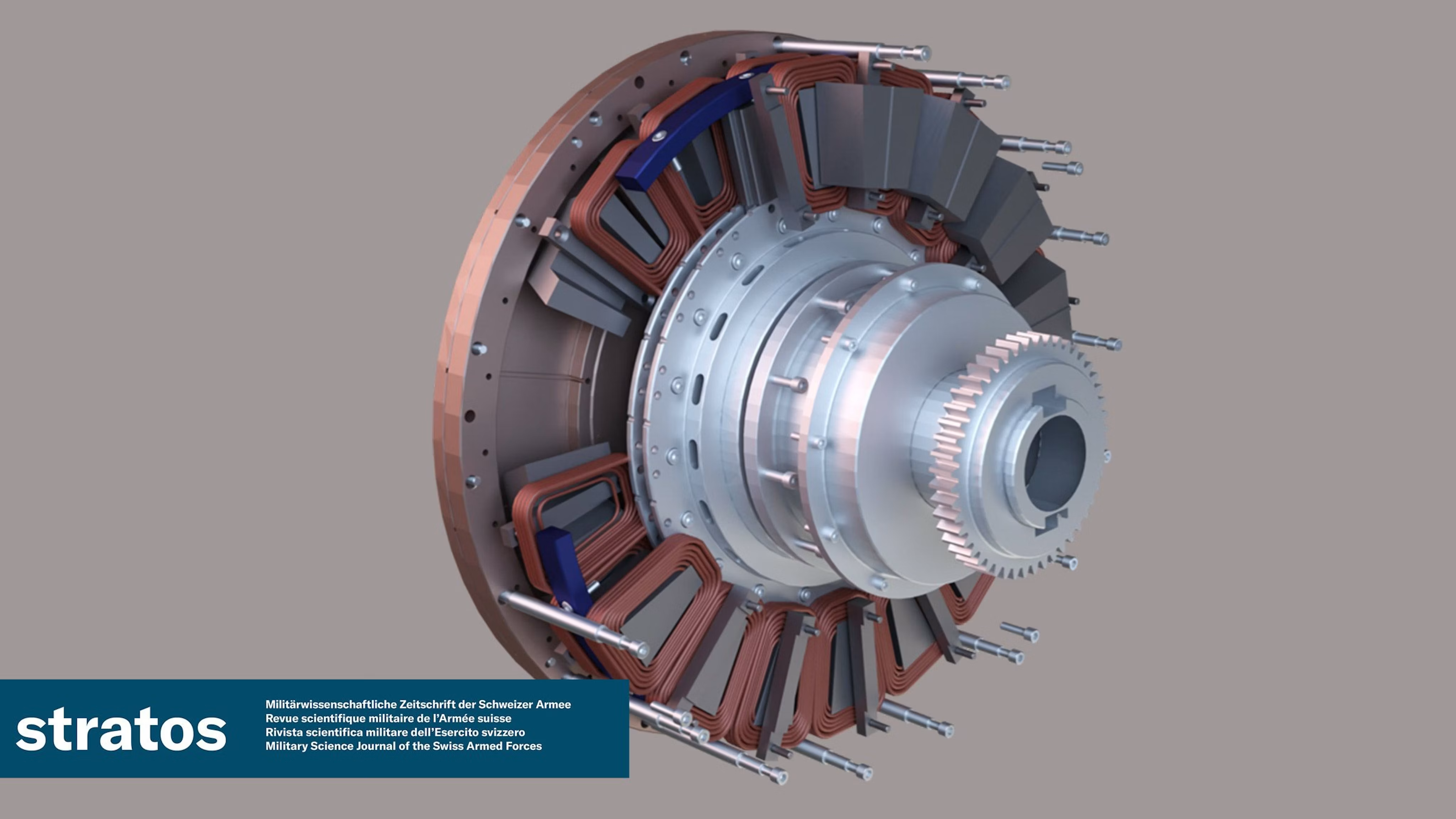
Most powertrain numbers come from the company selling the powertrain. Ours came from someone else.
In a field trial commissioned by armasuisse, the Swiss Confederation’s federal procurement and technology agency, our hybrid-electric drive was put through independent, application-oriented testing. The result: the drive cut CO₂ by roughly 39% and fuel consumption by up to 31% versus a conventional combustion drivetrain. Those figures come from the agency’s own assessment, not ours.
For a company whose whole proposition rests on the economics of running heavy machines, third-party validation at that level is the proof point that matters most.
Why a federal agency was interested
Switzerland has set itself a hard decarbonization target: net-zero by 2050, with an interim goal of cutting emissions at least 40% by 2030, and a large share of public-sector emissions comes from heavy vehicles. That makes net-neutral drivetrains a serious area of interest for federal technology programs, and it’s why armasuisse ran a field evaluation of new propulsion approaches. The 4QT drive, from an ETH Zürich spin-off based at the Innovation Park Zürich in Dübendorf, was one of the projects they looked at closely.
What the test confirmed
For working machines, a pure-electric motor usually isn’t practical: duty cycles are too demanding and charging too disruptive. A hybrid is the pragmatic path, but conventional hybrid drivetrains have carried enough drawbacks to limit their appeal. The trial set out to see whether our approach changed that calculus. It did:
~39% lower CO₂ in independent testing
Up to 31% less fuel for the same work
Greater range and uptime from the same tank: fewer refuels, less resupply logistics
On-demand silent, zero-emission running: lower noise, no tailpipe output when it’s needed
Broad applicability across vehicle classes: the same core architecture scales
The efficiency gains show up most clearly in mobile, variable-load applications, exactly the heavy, stop-start duty cycles our verticals run on.
What’s actually new in the drive
The innovation is deceptively simple: we combine the generator and the motor directly. That creates a hybrid architecture where the machine is fully electrified, with a combustion engine available purely as a range-extender: power generated onboard, when and where it’s needed, with energy recovered rather than wasted. The system behaves like an automatic transmission under computer control, feeding in power on demand and recovering it on the overrun. It’s a large part of why the drive achieves such high output for its size, and why the gains are biggest exactly where the work is hardest.
The architecture is patented. The idea traces back to 2015, when founder Marc Vetter, an ETH Zürich and MIT-trained mechanical engineer, first sketched it during a university lecture; the company was founded in 2020.
Why it matters
A federal agency had no incentive to flatter our numbers, which is precisely what makes the result useful. Independent confirmation of ~39% CO₂ and up to 31% fuel reduction is the kind of evidence an OEM or fleet operator can actually build a business case on. It’s the same core we now bring to construction, mining, agriculture, and ports: more work per litre, onboard power, and zero-emission running on demand, validated by people with no stake in selling it.
Read the original article (in German)